
EDMUND BRUMFITT RARE BOOKS
Rare books, manuscripts and ephemera from five centuries


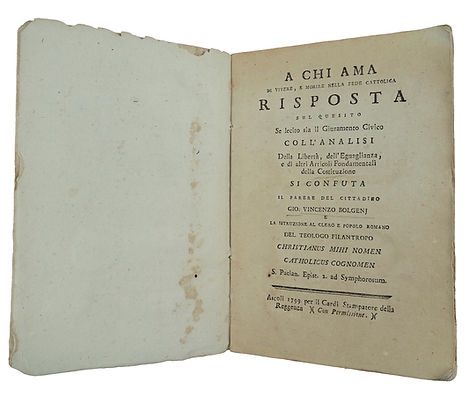

Civic Oath versus Catholic Oath in Napoleonic Rome
[ANON]. A CHI AMA DI VIVERE, E MORIRE NELLA FEDE CATTOLICA RISPOSTA sul questio Se lecito sia il Giuramento Civico coll’analisi Della Libertà, dell’Eguaglianza, e di altri Articoli Fondamentali della Constituzioe si confuta il parere del cittadino Gio. Vincenzo Bolegni e la istruzione al clero e popolo romano del teologo filantropo Christianus Mihi Nomen catholicus cognomen S. Pacian. Epist. 2 ad Symphorosum. Ascoli: per il Cardi Stampatore della Reggenza, 1799. £450
FIRST EDITION. Small 4to, pp. 108; some sections in two columns, typographic section breaks, initials and tailpieces; contemporary ms. booklet, 8vo, pp. [16], in brown ink, stitched to lower pastedown, creased from folding vertically and horizontally; scattered browning and foxing, some cockled pages and creased corners, some pencil markings, but otherwise a good copy, ms. booklet lightly foxed to first page and with occasional small marks, some worming to later pages; in contemporary printed wrappers, title printed on both covers with typographic border and ornaments to covers and spine; wrapper almost completely worn off spine, covers soiled and damp-stained, lower cover wormed, two circular impressions to upper cover, visible on first few leaves.
Rare, anonymous riposte to Giovanni Vincenzo Bolgeni’s (1733-1811) Parere sul giuramento civico (1798), in which the Jesuit theologian otherwise known for his anti-Jansenist polemic had controversially (and somewhat surprisingly) defended the civic oath which had been introduced with the establishment of Napoleon’s Roman Republic (1798-1800). Set out in Article 367 of the new Roman constitution, it runs: ‘Giuro Odio alla Monarchia, e all’Anarchia. Giuro Fedeltà ed Attaccamento alla Republica, e alla Costituzione.’ (‘I swear hatred of monarchy, and of anarchy: faithfulness and attachment to the republic, and to the constitution.’) The author analyses the components of this oath accepted by ‘cit. Bolgeni’, quoting his commentary and, alongside it, presenting each counterargument from the perspective of the ‘Cristiano Cattol.’. These include the arguments that a Christian cannot swear hatred of monarchy as an institution, that liberty without God is pure libertinism, that to preach in favour of equality is to reject Divine Providence, and that it cannot be legitimate to swear allegiance to a constitution which explicitly does not recognise vows made to God in the presence of the Church.
Bound at the end of the book is a manuscript booklet titled ‘Formola di Giuramento’, presumably the notes of an early reader. Examining the formulation, intention and object of an oath, it essentially summarises the arguments of the book. This author crucially begins by emphasising that oaths are by definition made ‘under the invocation of God’ (‘sotto l’invocazione di Dio’).
See De Felice, Renzo, ‘BOLGENI, Giovan Vincenzo’, DBI Vol. 11 (1969); Rochini, Marco, Il gesuita e la rivoluzione: Teologia e democrazia in Giovanni Vincenzo Bolgeni (1733– 1811), (Rome: Edizione Giugno, 2023); SBN: IT\ICCU\ANAE\014960; OCLC only records a single copy outside Italy, at Harvard.
[ref: 2677 ]