
EDMUND BRUMFITT RARE BOOKS
Rare books, manuscripts and ephemera from five centuries


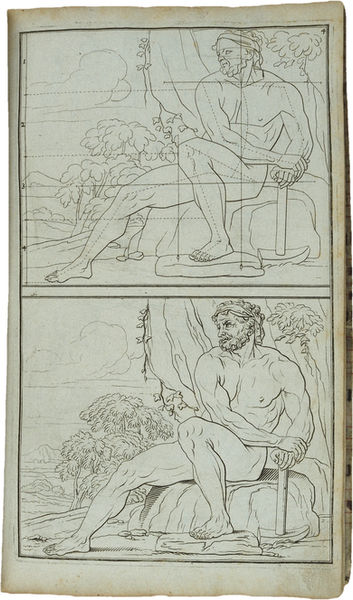

PREIßLER, Johann Daniel. DIE DURCH THEORIE ERFUNDENE PRACTIC, oder Gründlich-verfasste Regüln deren man sich als einer Anleitung zu berühmter Künstlere Zeichen-Wercken bestens bedienen kan. Erster [-Dritter und letzter] Theil. Zum drittenmahl aufgelegt, und herausgegeben von Johann Daniel Preißler... In Nürnberg: auch bey ihme zu finden, Anno MDCCXXXVI [1736], parts 2 and 3: 1730. £1,500
MIXED EDITION. Three parts in one volume, folio, pp. [12], 18 leaves of engraved plates; [8], 18 leaves of engraved plates; [7], [1] blank, 18 leaves of engraved plates; engraved frontispiece by Preißler to part one; sporadic dampstaining and foxing, some gatherings partially detatched from binding and corners slightly dogeared; in contemporary carta rustica covered with earlier vellum music manuscript from a Breviary, remains of leather ties; somewhat worn and dustsoiled, but still an appealing volume despite flaws.
An interesting copy, made up of the second (parts 2 and 3) and third (part 1) editions of this comprehensive manual of life drawing by the Nuremberg engraver and painter Johann Daniel Preißler (1666-1737).
First published between 1721 and 1725, Die durch Theorie erfundene Practic quickly became a very influential manual for art students not only in southern Germany but throughout Europe, being translated in parts into French and Italian, and going through at least eight editions into the 1780s (with posthumous editions expanded by Preißler’s son Johann Justin). Addressed to ‘lehr-begierige’ (eager to learn) youth, Preißler’s book offers comprehensive instructions, finely illustrated with hundreds of examples, on the drawing of eyes, ears, mouths, profiles, faces, hands, feet, arms, legs, backs, and torsos, before, in the second part, demonstrating how the various body parts should be combined in proportion, in a variety of poses (standing, seated, kneeling, exercising). The third part (the final one to be Preißler’s work) then deals with the techniques used in depicting light and shadow and clothing; Preißler recommends that students copy his examples using the principles he outlines, but also that they then apply the same techniques to reproducing drawings by the likes of Raphael, Poussin, and others.
Preißler was born into a prominent artistic family in Nuremberg, and made his reputation locally with portraits and frescos. He spent time in Rome and Venice between 1688 and 1696, before returning to Nuremberg where, in 1705, he became the director of the city’s Kunstakademie, a position he held until his death. He published several drawing manuals, starting in 1706 with a translation of Carlo Cesio’s L’Anatomica dei Pittori, but it is for the present work that he is best remembered. Later editions, continued by his son, expanded to include introductions to botanical drawing and landscape. “Besides training artists, Preißler had a lasting influence on the fundamentals of academic art education; his name is inextricably linked to the history of German art education” (Grieb, p. 1173).
M.H. Grieb (ed.), Nürnberger Künstlerlexikon, Munich, Saur, 2007; Thieme/Becker XXVII, 374.
[ref: 2650 ]
